AixRays
SunFlower the world.
A full year of optical simulation for an 8 600-heliostat field, in 2.3 seconds
at under 0.05% error.
Planning a solar tower means tracing trillions of rays.
One annual energy simulation of a plant the size of Gemasolar means 50 moments across the year at 10 million rays each. That is 500 million rays. Finding the optimal heliostat field layout means running that simulation thousands of times over: roughly 1.25 trillion rays for a single field design.
Conventional ray tracers need hours or days for this, so the usual answer is to simulate fewer moments, with fewer rays, at lower accuracy, and accept a field layout designed against a blurred picture of reality.
SunFlower removes that trade-off. It is fast enough that full accuracy stops being something you ration.
Measured on real plants.
Annual simulation, 50 moments per year, error below 0.05%.
- 0.4 sPS10624 heliostats
Cavity receiver
4 million rays per moment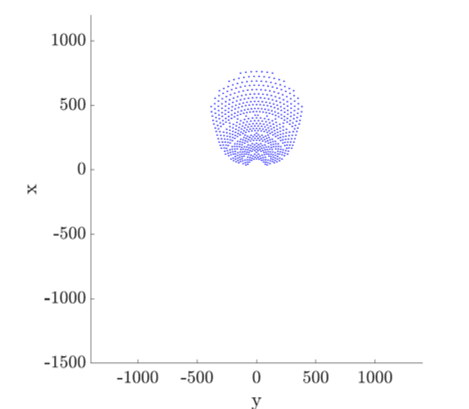
- 0.9 sGemasolar2 650 heliostats
External receiver
10 million rays per moment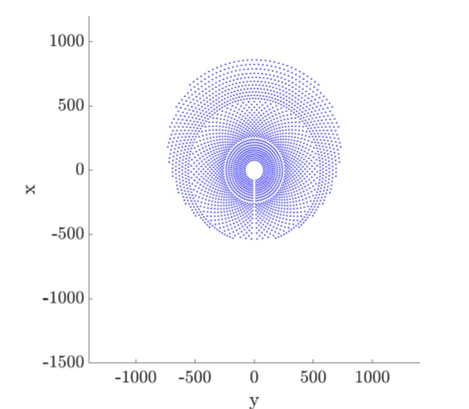
- 2.3 sAbengoaCRS8 600 heliostats
External receiver
30 million rays per moment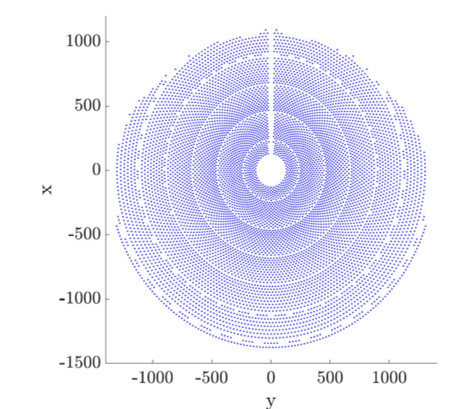
All three fields are drawn to the same scale. The largest covers 1.2 million square metres of mirror. Its full-year simulation finishes in the time it takes to read this sentence.
How it gets there.
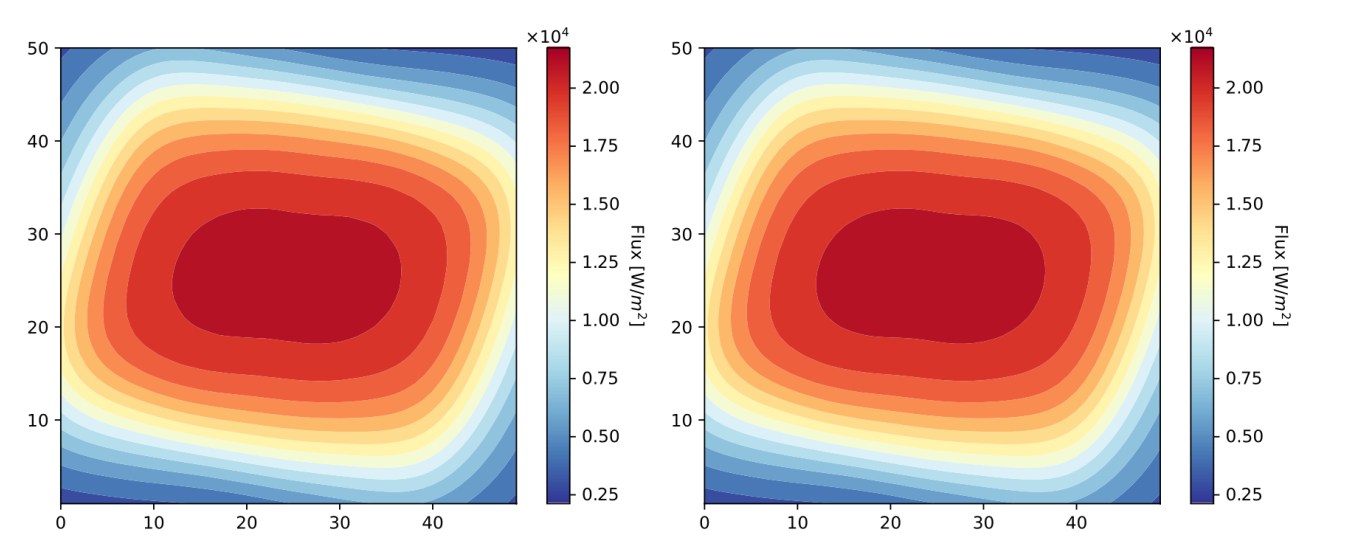
Integrated convolution
Instead of firing random rays and waiting for the noise to average out, optical errors are treated analytically as a Gaussian distribution and integrated across a whole mirror facet at once. The solution converges with ray count rather than fighting it.
GPU parallelisation
Ray tracing spreads across thousands of GPU cores, a roughly 50× speedup over the equivalent CPU implementation. That is why a full year of simulation fits into seconds rather than hours.
Honest annual sampling
Standard approaches assume the year is symmetric and sample it accordingly. Real weather-station TMY data is not symmetric. SunFlower samples in celestial coordinate systems that fit the data you actually have.
Cross-checked against SolTrace.
Fast is only worth something if the answer is right, so we check ours against a tool the industry already trusts. SunFlower exports any project straight to SolTrace and Tonatiuh, which means the same geometry can be run in both and the numbers compared directly.
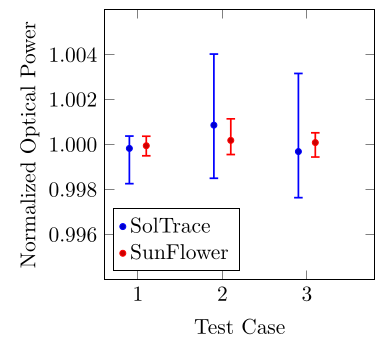
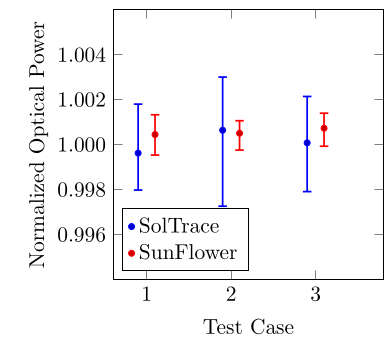
Three sun positions were simulated for each plant, from low morning sun through to near-overhead, and each case was run ten times in both tools. The averages agree to better than 0.09%. SunFlower is also the steadier of the two: its spread across repeat runs is 0.18% against SolTrace's 0.55%, because it generates rays on the mirror surface instead of wasting them on the ground. The full method and results are in our 2023 paper in Solar Energy.
Then design a better field with it.
Simulation tells you what a field would produce. The optimizer tells you where to put the mirrors. That is the part worth money, because a layout is fixed on the day it is built and then runs for twenty-five years.
We ran it against two plants that real engineers had already designed and built, in Seville. Same site, same hardware, same heliostat count. Only the positions moved.
- +1.8%PS10more annual optical power
- +6.3%Gemasolarmore annual optical power
What you get.
Ultrafast Raytracer
GPU-accelerated ray tracing at full accuracy.
Three ray tracing methods, parallelised across thousands of GPU cores, with analytic treatment of sun, tracking and slope errors. Flat tilted, cavity and external receivers. On-axis and off-axis canted heliostats with triangular facets.
Heliostat Layout Optimization
Field layouts optimised against real conditions, not idealised ones.
Extended pattern approaches search thousands of candidate layouts, accounting for local solar and atmospheric conditions, receiver geometry, tower height and land boundaries.
Aiming Strategy
Aim point management via linear programming.
Computes flux-limited aim point assignments at any solar position, using exact optimisation accelerated by heuristic constraints.
Web ApplicationComing soon
The full suite in the browser.
A platform-independent interface to the same simulation core, so you can set up runs and follow optimisation progress without a local install.
Who uses it.
SunFlower is used by researchers, technology developers and academics to evaluate performance and provide independent validation for privately developed tools, including Heliogen, who use it in their concentrated solar work. The methods behind it are published and peer-reviewed across more than fifteen papers in Solar Energy, the Journal of Renewable Energy and the SolarPACES proceedings.
Try it on your own field.
The API is open for free evaluation. Ask us for a key, point the example Postman collection at your own geometry, and get a full efficiency breakdown back: cosine, shading, blocking, reflectivity, atmospheric attenuation and spillage, hour by hour.
Licensing is modular. The ray tracer, the layout optimiser and the aiming strategy are each an annual licence, with support and maintenance included. Tell us what you need and we will quote for it.
Get in touch.
Dr. Pascal Richter